
 Español
 Pусский
 Deutsch
 日本語
日本語 한국어
한국어 हिन्दी
 Indonesia
 Melayu
 Tiếng Việt
Continuous Flow Microchannel Photoreactor
A Continuous Flow Microchannel Photoreactor is an advanced type of chemical reactor designed to carry out light-driven reactions in a highly controlled and efficient manner. It combines three important concepts: continuous flow processing, microchannel technology, and photochemical activation. This combination makes it especially valuable for reactions that require precise light exposure, rapid mixing, and excellent heat management.In a continuous flow system, reactants are continuously pumped through the reactor instead of being held in a single large vessel. This allows the reaction to proceed steadily, with product being collected at the outlet while fresh reagents enter at the inlet. Compared with batch processing, continuous flow offers better reproducibility, safer operation, and easier scale-up. It is particularly useful for reactions involving unstable intermediates or hazardous reagents, since only a small volume is present in the reactor at any time.The microchannel structure refers to very small flow passages, often ranging from micrometers to a few millimeters in size. These narrow channels provide a very large surface-area-to-volume ratio, which greatly improves mass transfer and heat transfer. For photochemical applications, this is highly advantageous because light can penetrate more uniformly through thin fluid layers. In conventional large reactors, light often cannot reach the full depth of the reaction mixture, leading to inefficient conversion and uneven product quality. In a microchannel photoreactor, the short optical path ensures that the entire stream receives consistent irradiation.The photoreactor uses light as the driving force for chemical transformation. Depending on the reaction, it may employ ultraviolet, visible, or near-infrared light sources. Light activates a photocatalyst, initiates radical formation, or directly excites reactive molecules. Because the reactor geometry is compact and transparent or semi-transparent, the emitted light interacts efficiently with the flowing solution. This enables faster reaction rates and improved selectivity in many cases.Another major benefit of this reactor design is temperature control. Photochemical reactions can generate heat, and some are sensitive to overheating. The small dimensions of microchannels allow rapid removal of excess heat, helping maintain stable reaction conditions. This reduces side reactions and improves product consistency. In addition, the continuous movement of fluid minimizes the risk of local hot spots, which are common in larger reactors.Continuous flow microchannel photoreactors are widely used in organic synthesis, pharmaceutical development, fine chemical production, and materials science. They are suitable for photocatalytic oxidation, reduction, cycloaddition, halogenation, and other light-induced transformations. Researchers value them because they support fast optimization, safe handling of reactive species, and straightforward process intensification.Overall, a Continuous Flow Microchannel Photoreactor represents a powerful platform for modern chemical manufacturing. By combining continuous operation, micro-scale channel design, and efficient light delivery, it achieves high reaction efficiency, better safety, and strong scalability. These advantages make it an important technology for both laboratory research and industrial production.
Products
Category:
-
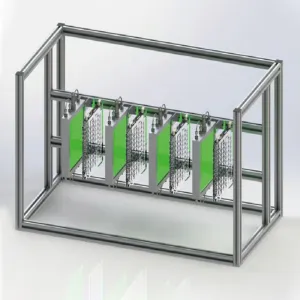
Microchannel photochemical reactor
Category: Microfluidic Photochemical ReactorsBrowse number: 833Number:Release time: 2026-07-10 09:48:18Microchannel photochemical reactors integrate microreaction technology with photochemistry, serving as a platform that enables more efficient,precise and safe utilization of lightenergy for chemical reactions.Compared with traditional batch tankreactors,they achieve substantial improvements in light energy utilization, mass and heat transfer, reaction rate and operational safety, making them core equipment for modern fine chemical engineering, pharmaceutical synthesis and new material preparation.
News
Category:
-
[Blog]LED Photochemical Reaction Vessel Application Guide
2026-08-16 03:22:46
Case
Category:
No search results found!
Video
Category:
No search results found!
Download
Category:
No search results found!
Job
Category:
No search results found!
Featured Products
-
NEWS
Microchannel photochemical reactor
Learn more



 WhatsApp
 Phone
Phone